WELLNESSVIGOR · EVIDENCE-BASED HEALTH
The Cancer Prevention Questions That Actually Matter
In 2024, an estimated 20.6 million people worldwide were diagnosed with cancer—and 9.8 million died from it. About 1 in 5 people will develop cancer during their lifetime.
And the global burden is expected to grow. The latest estimates from the International Agency for Research on Cancer (IARC) project 34.4 million new cancer cases by 2050—about a 67% increase compared with 2024.
But here’s the problem:
Cancer prevention advice is everywhere. One headline says a food protects you. Another warns that an everyday product is dangerous. A third promises that a particular habit can dramatically lower your risk.
The harder question is not “What should I worry about?” It is “What actually matters?”
Why Cancer Prevention Advice Can Be So Confusing
Search for almost any cancer-prevention question and you will find an overwhelming amount of information. Some of it is useful. Some is based on preliminary research. Some takes an association and turns it into a certainty.
This creates a problem: people can spend enormous amounts of energy worrying about small or uncertain exposures while overlooking better-established risk factors.
A more useful approach is to ask:
- How strong is the evidence?
- Is the finding an association or evidence of causation?
- How large is the effect?
- Is the exposure common enough to matter in everyday life?
- Do multiple studies point in the same direction?
- What remains uncertain?
- Is there a practical action that makes sense?
Start With the Risks That Have the Strongest Evidence
Not every possible cancer risk deserves the same amount of attention. Some exposures and behaviors have much stronger evidence behind them than others.
Tobacco is a clear example. Alcohol and ultraviolet exposure are also important areas of cancer-risk research. Other factors, such as body weight, physical activity, diet, sleep, and environmental exposures, involve different kinds of evidence and different degrees of certainty.
The practical lesson is simple: prioritize before you optimize.
What About Food and Sugar?
Nutrition is one of the easiest areas for cancer-prevention information to become oversimplified.
Individual foods are often presented as either “cancer-fighting” or “cancer-causing,” but real-world cancer risk is rarely that simple. Dietary patterns, body weight, metabolic factors, overall energy intake, and other lifestyle factors can interact in ways that make individual-food headlines difficult to interpret.
That does not mean food is irrelevant. It means the better question is often: What overall eating pattern is realistic and sustainable?
Exercise Is About More Than the Number on the Scale
Physical activity is another area where the conversation can become too narrow. Exercise is often discussed only as a way to control body weight.
But research on physical activity and cancer risk raises a broader question: could movement matter independently of weight?
A sensible prevention strategy does not have to begin with an extreme workout program. Regular movement can simply become part of the environment of everyday life.
Sleep, Fasting, and the “Starving Cell” Idea
Sleep and fasting have become major topics in health content. Both also illustrate why scientific evidence needs context.
Sleep research includes questions about the body clock, circadian rhythms, and patterns of night-time exposure. Fasting research includes cellular processes such as autophagy and questions about how fasting may interact with metabolism.
But a biological mechanism is not automatically proof that a particular consumer health practice prevents cancer in humans.
What About Plastics and Everyday Environmental Exposures?
Environmental exposure is another area where people understandably want clear answers. Microplastics and nanoplastics, for example, have attracted substantial public attention.
The important distinction is between detecting an exposure, demonstrating a biological effect, establishing a human health association, and determining how large the real-world risk may be.
These are different questions.
That is why practical decisions can be useful even when science is still developing. Instead of trying to eliminate every possible exposure, a more rational approach is to identify situations where reducing exposure is relatively easy and reasonable.
Prevention Is Not the Same as Early Detection
One of the most important distinctions in cancer discussions is the difference between preventing cancer from developing and finding cancer earlier.
Screening can play an important role in certain cancers and populations, but screening is not identical to prevention. It can involve benefits, limitations, false positives, and follow-up procedures.
Understanding that distinction helps people have more informed conversations about screening rather than treating every screening test as a guarantee against cancer.
The Bigger Question: What Should You Actually Do?
The goal of cancer prevention should not be to make people afraid of everything.
A useful framework is to separate actions into different levels of priority:
- High-confidence actions: areas where the evidence is relatively strong.
- Worth paying attention to: factors that may matter and are practical to address.
- Emerging science: interesting areas where important questions remain unresolved.
- Don’t waste your energy: claims that receive enormous attention without strong evidence that they deserve it.
This kind of prioritization can be more useful than collecting an endless list of things to fear.
Build Your Own Cancer-Risk Reduction Map
Instead of trying to change everything at once, start by looking at your own environment and routines.
- What major exposures can I realistically reduce?
- Where could I improve my daily movement?
- How consistent is my sleep schedule?
- What does my overall eating pattern look like?
- Which changes would be easiest to maintain?
- Which concerns are supported by strong evidence, and which are mostly internet noise?
The objective is not perfection. It is to make a series of sensible decisions that fit real life.
Want the Complete Cancer Prevention Guide?
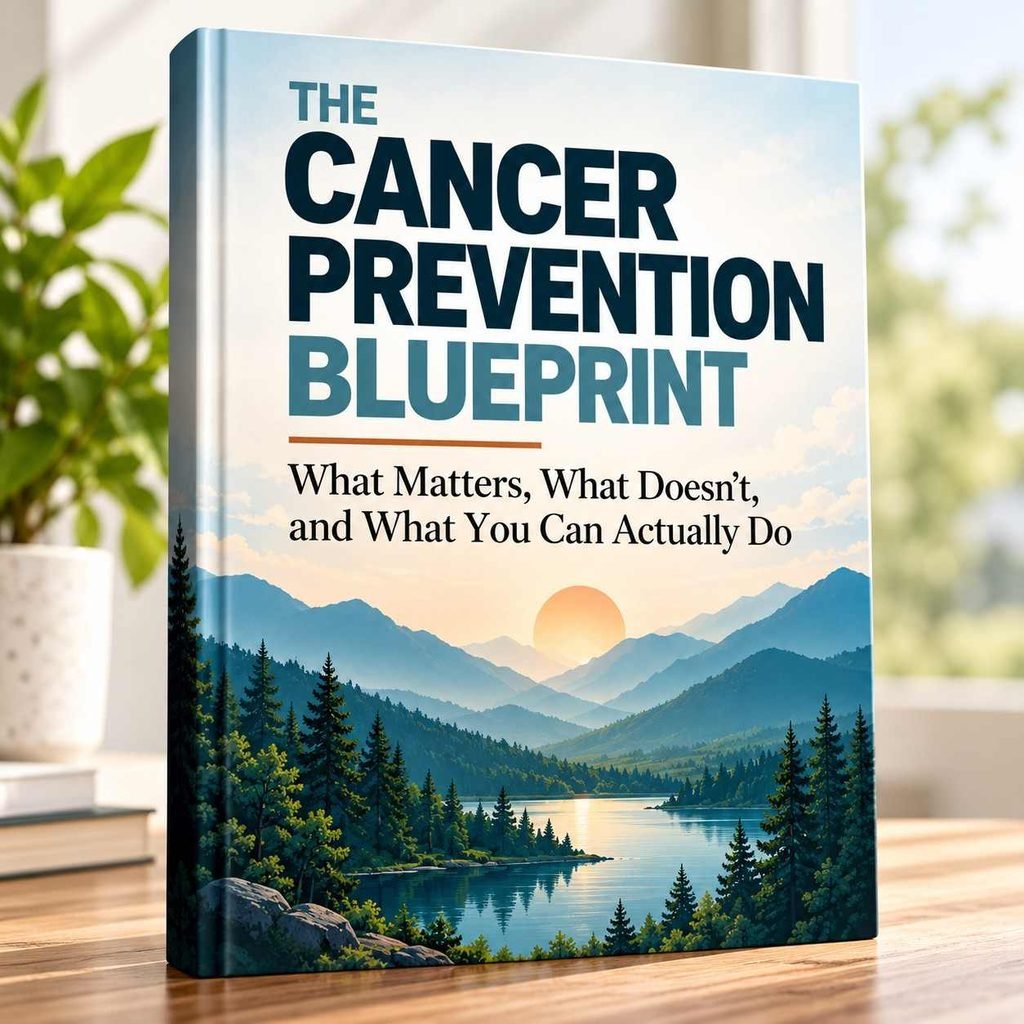
The Cancer Prevention Blueprint goes much deeper into the evidence, major risk factors, environmental exposures, cancer myths, screening, practical decision tools, and a personal 30-day risk-reduction plan.
It is designed to help you understand what matters, what doesn’t, and what you can actually do.
Get The Cancer Prevention BlueprintFinal Thought
Cancer prevention is not about finding one magic food, one perfect routine, or one hidden cause.
It is about understanding risk, recognizing stronger evidence, accepting uncertainty where it exists, and putting your attention where it is most useful.
The best question to keep asking is:
What actually matters—and what can I realistically do about it?
Explore the Full Blueprint
122 pages of evidence-focused explanations, practical tools, myth filtering, and a personal risk-reduction framework.
Visit WellnessVigor on GumroadThis article is for general educational purposes and is not medical advice. Cancer risk varies between individuals. Discuss personal screening and medical concerns with a qualified healthcare professional.